Research Innovations series explores dental fear and trust, oral cancer
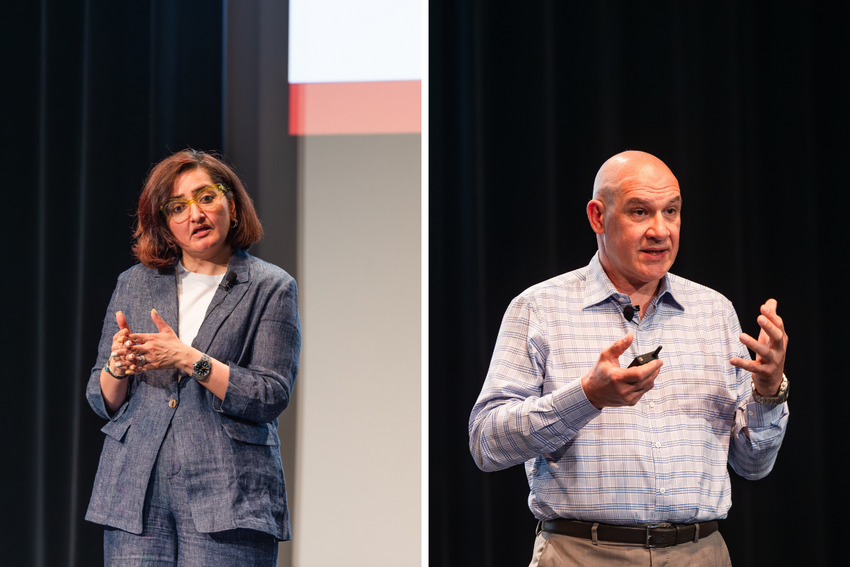
The School of Dentistry celebrated discovery that impacts care at the annual Research Innovations Seminar Series event, held Friday, June 12.
Inspired by the school’s mission to advance health through scientific discovery, innovative education and the highest-quality care for all communities, the Research Innovations Seminar Series invites experts to showcase their research and discovery to a wide audience, condensing complex and difficult questions into a digestible format. Approximately 75 individuals from the School of Dentistry community attended this year’s talks.
Kristin Artinger, PhD, Associate Dean for Research and Discovery and now Interim Dean, welcomed attendees and reminded them of the School of Dentistry’s mission to advance health through scientific discovery, innovative education and the highest quality care for all communities.
Tamanna Tiwari, MPH, MDS, BDS, FACD, associate professor of dental public health and Chair of the Department of Primary Dental Care, kicked off the event with “Healing more than teeth in Native American communities: Trust, trauma and care.”
Reflecting on her time working with Native communities on the Pine Ridge Reservation, Tiwari recalled inquiring as to why community members wait so long to seek dental care. What seemed like a simple question led to an exploration of how trauma, patient-provider trust and other psychosocial experiences impact and shape dental care utilization.
“Suddenly, this was no longer just a question about access to care,” she explained. “It became a question about trust, fear, and trauma. In the case of Native American communities, it is generational trauma. And about whether dental healthcare systems feel emotionally safe for the communities they serve.”
Using a mixed-methods approach, Tiwari explained, her team found that nearly one in five American Indian/American Native adults reported high levels of dental anxiety and distrust in dental providers. Relying on survey data, community-engaged quantitative research and qualitative findings from communities, Tiwari and her team identified the link between perceived discrimination, decreased provider trust and lower likelihood of seeking dental care. In identifying these links, Tiwari explained, she and her team opened the door to community advisory boards and other methods for enhancing trust between patients and providers.
“Trust is built through relationships, collaboration, transparency, and shared power,” she explained. “Our role as researchers is not to arrive with all the answers. Our role is to create space for communities to shape the questions, guide the science, and define what healing should look like in their own communities.”
Massimo Costalonga, DMD, PhD, professor of basic sciences, then shared his presentation, “Who is protecting from oral cancer?”
Costalonga provided an overview of the mechanisms by which the immune system recognizes cancerous mutations and their protein sequences, resulting in the activation of CD8 cells to destroy tumors, and the scenarios in which this destruction does not happen—leading to the spread of oral cancer.
“We’re trying to dissect the mechanisms of why certain T-cells that are capable of killing tumors do not become killer cells,” he explained. “That’s the focus of our research. And that’s how we’ll answer the question of, ‘who is the protector of cancer?’”
Following both presentations, the speakers engaged in a question-and-answer session with the audience.
Artinger concluded the event with an invitation to the researchers in the audience: “I encourage you all, as you leave today, to think about how your research and discovery will inform patient care in the future—and how your work fits into our mission.”