Kress represents School of Dentistry at tenth annual Three Minute Thesis
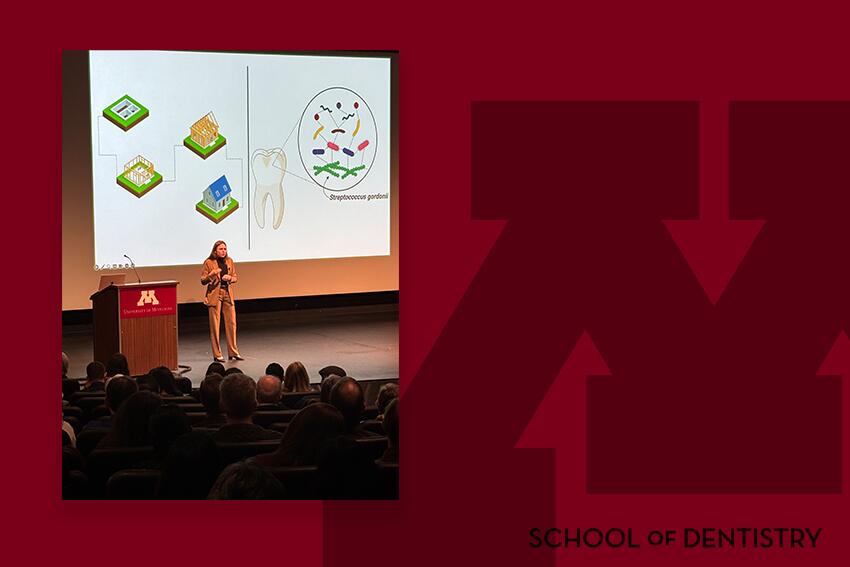
Lauren Kress, DDS/PhD ’31, represented the School of Dentistry at this year’s Three-Minute Thesis competition.
Hosted by the graduate school, this year was the tenth University-wide competition and featured finalists from college- and school-level competitions.
First developed by the University of Queensland, Three Minute Thesis invites participants to share their research in a condensed, approachable format.
Kress first won the school’s competition with her presentation, “Streptococcus gordonii: A ‘foundation’ for dental plaque.”
“My research is rooted in oral microbiology and bacterial genetics,” she explained. “I am interested in understanding how post-translational modifications of regulator proteins within Streptococcus gordonii impact its ability to interact with the oral environment and form a biofilm on the tooth surface.”
She decided to participate in an effort to enhance her communication skills and practice making complex scientific inquiry more accessible and available to the public. “I’ve found that scientists sometimes get caught up in the detailed data of a project and struggle to translate the impacts or importance to those outside the field,” she reflected. “The 3MT model provides an excellent opportunity to practice effective scientific communication to a general audience—and it’s fun!”
Kress enjoyed the “fun and encouraging atmosphere” of the school-level competition, which allowed her to compete—and celebrate—with colleagues. “It felt more like a celebration of our hard work and research interests than a competition,” she said.
The University-wide competition was “rewarding,” especially because Kress used to be afraid of public speaking engagements. She enjoyed the opportunity to meet with a 3MT consultant to refine her presentation and loved hearing more about the research happening across the University.
“I don’t often get to hear about what’s going on outside the health science complex, so the 3MT format provided an excellent snapshot of the important work happening in other programs,” she said. “Watching the other presentations also inspired me to continue to find creative ways to communicate my own research in the future.”
Kress hopes her presentation was similarly impactful on the other students in attendance, and that they “could appreciate the importance of studying the mechanisms driving biofilm formation by oral bacteria,” she said.
“Beyond the impacts of dental plaque on oral health, we are continually discovering the connections between oral and systemic health. In other words, our oral bacteria impact our health far beyond our mouth.”